
Table of Contents
Introduction – A New Chapter in Developer Evolution
In 2025, developers aren’t just writing code — they’re commanding armies of intelligent agents that do it for them.
The age of the “Agent Manager” has arrived — a new role where developers design workflows, assign high-level goals, and supervise swarms of AI workers. This shift is not science fiction. It’s being built today by open-source projects like Devika and AutoDev, and even integrated into platforms by big players like OpenAI, Anthropic, and Meta.
Need Fast Hosting? I Use Hostinger Business
This site runs on the Business Hosting Plan. It handles high traffic, includes NVMe storage, and makes my pages load instantly.
Get Up to 75% Off Hostinger →⚡ 30-Day Money-Back Guarantee
So, what does this mean for the future of development?
It’s no longer about writing every single line of code. It’s about telling your agents what to build, how to debug it, and when to ship. The keyboard remains, but the commands are higher-level, and the thinking is more architectural than mechanical.
This post will take you through the rise of the Agent Manager role — what it is, how it works, tools to get started, and what this means for you as a modern developer.
What is an Agent Manager Developer?
In the evolving landscape of software development, the Agent Manager Developer isn’t a coder in the traditional sense — they’re more like a conductor of an AI-powered orchestra.
Instead of writing hundreds of lines of logic manually, they design tasks, assign goals, and oversee outcomes generated by intelligent agents like Devika, AutoDev, OpenDevin, or custom AutoGPT setups.
These agents can:
- Interpret feature requests
- Search for APIs and documentation
- Write and refactor code
- Generate tests
- Debug errors
- Even deploy apps
The Agent Manager’s job is to define the strategy and evaluate outputs, not micromanage the process.
This isn’t just delegation. It’s developer evolution — a shift toward systems thinking, architecture, and high-level command.
Tools Powering Agent Manager Workflows in 2025
To manage autonomous coding agents effectively, developers need the right set of tools — not just code editors or Git, but agent orchestration platforms, multi-agent frameworks, and task delegation pipelines.
Here are the top tools empowering Agent Manager Developers:
🔹 1. OpenDevin
- Open-source DevOps-focused agent platform.
- Handles tasks like code generation, PR creation, testing, and even CI/CD.
- Popular for full-stack automation in teams.
🔹 2. Devika
- Natural language to code assistant.
- Integrates with your IDE and browser.
- Can reason, search docs, and build web apps from prompts.
🔹 3. AutoDev
- Supports running multiple agents in parallel.
- Has a GUI dashboard for live monitoring of AI activities.
- Built with developer security and feedback loops in mind.
🔹 4. CrewAI + LangGraph
- Create multi-agent teams with defined roles.
- Best for scalable applications and large projects.
🔹 5. Open Interpreter (Code Agent)
- Acts like ChatGPT but with access to your terminal, files, and APIs.
- Great for running local automation pipelines.
Section 4: Real-World Use Cases of Agent-Managed Projects
As the Agent Manager role gains traction, real-world applications are already proving that autonomous coding agents aren’t just hype — they’re productivity multipliers. Let’s explore how developers and companies are deploying multi-agent systems to reshape software delivery.
🔹 Use Case 1: Full App Development by Agents
Scenario: A developer defines a prompt like “Build a basic SaaS invoice tracker using React and Node.js.”
Agents Involved:
- Planner Agent: Breaks down the project into modules.
- Frontend Agent: Writes React UI.
- Backend Agent: Builds REST APIs.
- QA Agent: Runs test cases.
- Deployment Agent: Ships to Vercel or AWS.
Outcome: MVP ready in hours instead of weeks.
🔹 Use Case 2: Legacy Code Refactoring
Scenario: Company has a 100k+ line legacy codebase.
Agents Involved:
- Codebase Analyzer Agent: Maps old dependencies.
- Refactor Agent: Updates syntax, applies patterns.
- Test Agent: Ensures backward compatibility.
Outcome: Modernized code with minimal human effort.
🔹 Use Case 3: Multi-Language Documentation Creation
Scenario: A mobile app needs documentation in English, French, and Hindi.
Agents Involved:
- Content Agent: Writes original docs.
- Translator Agents: Localize into target languages.
- SEO Agent: Optimizes text for search engines.
Outcome: Fully localized, SEO-optimized docs generated autonomously.
🔹 Use Case 4: Daily DevOps Monitoring
Scenario: A DevOps team needs real-time insights and quick fixes.
Agents Involved:
- Monitor Agent: Tracks system health.
- Alert Agent: Flags issues.
- Fix Agent: Triggers predefined CI/CD fixes.
Outcome: Downtime reduced drastically.

Skills Required for Future Agent Managers
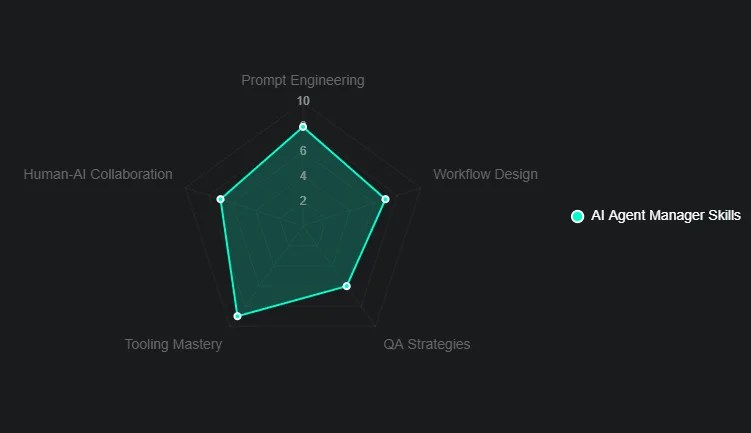
As developers transition into Agent Managers, the skillset required goes beyond writing code — it involves orchestrating intelligent systems, managing workflows, and ensuring quality outcomes without touching every line of code. Below are the key competencies that define the next-gen developer.
🧠 1. Prompt Engineering
Why it matters: Agents don’t guess — they follow instructions.
Skills to build:
- Writing structured, layered prompts
- Using system prompts for persona control
- Iterating based on agent feedback
🔄 2. Workflow Design
Why it matters: Multi-agent systems thrive on well-defined stages.
Skills to build:
- Designing input/output flows between agents
- Mapping dependencies between agent tasks
- Using visual tools (like LangGraph or ReAct) to structure tasks
🧪 3. Validation & QA Strategies
Why it matters: Agents can hallucinate or output wrong code.
Skills to build:
- Building agent validators (test writers, static analyzers)
- Using checksum tools, linters, and automated tests
- Manual review triggers for critical code paths
🔧 4. Tooling Mastery
Why it matters: Agent managers must use the right platforms.
Skills to build:
- LangChain, OpenAgents, CrewAI familiarity
- Vector DBs (like Chroma or Pinecone) for context management
- Model tuning and RAG (Retrieval Augmented Generation)
👥 5. Human-AI Collaboration Mindset
Why it matters: You’re managing, not replacing.
Skills to build:
- Knowing when to override or guide an agent
- Balancing automation with ethical oversight
- Communicating outcomes clearly to stakeholders
Tools and Frameworks Powering Agent-Based Development
The rise of agent-based development has brought an explosion of new tools and frameworks that empower developers to build, orchestrate, and scale intelligent multi-agent systems. These platforms handle everything from communication and memory to task routing and execution.
Below is a breakdown of the most impactful tools in the Agent Manager’s toolbox:
🧰 1. LangChain
Purpose: Orchestrate complex agent workflows and chains.
Key Features:
- Agent + tool integration
- Memory management (short- and long-term)
- Routing logic and conditional flows
Use Case: Deploying agents that query APIs, analyze text, and respond in context.
🧩 2. CrewAI
Purpose: Structured multi-agent collaboration with roles.
Key Features:
- Define “crew members” with goals and tools
- Human-agent handoffs
- Team-based architecture
Use Case: Simulating a team of specialists (e.g., a coder, reviewer, and tester).
🔁 3. LangGraph
Purpose: Graph-based agent orchestration.
Key Features:
- Visual and node-based task flow
- Cyclic agent calls
- Async execution
Use Case: Use for scenarios like bug triaging or build-test-deploy loops.
🧠 4. OpenAgents
Purpose: Open-source platform for building and sharing agents.
Key Features:
- Agent marketplace
- RAG pipeline integration
- Easy API layer for interaction
Use Case: Plug-and-play agents for customer support, dev ops, etc.
🧭 5. ReAct Framework
Purpose: Integrate reasoning + acting into agents.
Key Features:
- Thought + action loops
- Chain-of-thought reasoning
- Decision traceability
Use Case: Ideal for complex problem-solving with logical breakdowns.
🧠 6. AutoGen by Microsoft
Purpose: Build custom multi-agent workflows.
Key Features:
- Agents with memory and communication
- GUI-based and code-based setup
- Integration with Azure services
Use Case: Ideal for enterprise-level automation.
Real-World Use Cases of Agent-Based Development
As agent-based development becomes more practical, it’s already being tested and adopted in several real-world scenarios—both by startups and large enterprises. Below are impactful examples showing how agents are solving actual problems and transforming workflows.
🏢 1. Enterprise Code Automation
Example: A tech company uses a suite of agents to automatically generate, test, and deploy microservices.
Agent Roles:
- Coder Agent: Generates boilerplate and logic
- Reviewer Agent: Performs code quality checks
- DevOps Agent: Automates deployment pipelines
Impact: Reduced time to deploy new features by 60%.
📚 2. Knowledge Management & Summarization
Example: An AI startup deploys multi-agent systems to summarize 1000+ internal documents weekly.
Agent Roles:
- Reader Agent: Parses PDFs and documents
- Summarizer Agent: Condenses into key points
- Tagging Agent: Applies metadata and organizes content
Impact: Saves 30+ human hours per week in knowledge curation.
💬 3. AI Customer Support Crew
Example: A SaaS platform integrates a team of agents to handle support tickets.
Agent Roles:
- Classifier Agent: Sorts and tags tickets
- Solver Agent: Retrieves answers from documentation
- Escalation Agent: Flags urgent cases to human staff
Impact: 70% of support cases are resolved without human intervention.
🧪 4. QA and Testing Automation
Example: A game dev company uses agents to run dynamic tests on builds.
Agent Roles:
- Explorer Agent: Simulates user behavior in-game
- Reporter Agent: Logs and ranks bugs based on severity
- Patch Agent: Suggests hotfixes for simple issues
Impact: Finds bugs faster and allows continuous deployment.
🧠 5. Personalized Learning Systems
Example: An ed-tech firm deploys agents for AI tutors.
Agent Roles:
- Diagnostic Agent: Identifies knowledge gaps
- Teaching Agent: Explains concepts with examples
- Motivation Agent: Gives encouragement based on student behavior
Impact: Boosts learning outcomes by 40% in early tests.

Skills Every Developer Will Need in the Age of Agents
As AI agents evolve from helpful assistants to full-blown co-developers, the skills required of a human developer are shifting rapidly. Mastering the right mix of technical, strategic, and communication skills will be essential in this agent-first development era.
1. Prompt Engineering and Agent Design
- Understand how to structure instructions clearly.
- Ability to chain agent behavior through system prompts or workflows.
- Skills in persona definition and setting task boundaries.
🔍 Why it matters: Just like developers used to optimize code, now they’ll need to optimize agent interactions for reliability and performance.
2. System Architecture and Orchestration
- Know how to build agent-based pipelines and workflows.
- Understand how agents interact via APIs, message queues, or graphs.
- Familiarity with orchestration tools like AutoGen, CrewAI, LangGraph, etc.
🧠 This is the new full-stack: From agent input/output handling to feedback loops, orchestration is becoming a new layer in app architecture.
3. Validation, Evaluation, and Feedback Loops
- Learn to build agent testing frameworks.
- Use tools to evaluate responses for factual accuracy and reliability.
- Integrate human-in-the-loop systems for continuous improvement.
🧪 You’ll spend as much time testing agents as you used to debugging code.
4. Security and Ethical Thinking
- Know the risks of agent misalignment, jailbreaking, and prompt injection.
- Understand data privacy, especially with agents that access sensitive systems.
- Build safeguards into agent permissions and autonomy levels.
⚠️ With great agent power comes great security responsibility.
5. Collaboration, Communication, and Meta-Coding
- Ability to explain AI decisions to team members and stakeholders.
- Write documentation for multi-agent workflows.
- Think at a meta-level—not just about what code does, but how agents think.
💬 Your code comments might now be read by a machine agent, not just a teammate.
📌 Bonus: New Job Titles on the Rise
- AI Agent Architect
- Prompt Pipeline Engineer
- Agent Behavior Analyst
- Autonomous DevOps Strategist
These roles are already appearing in forward-thinking organizations.
Tools and Platforms Powering the Agent Era
As AI agents become integral to modern software development, a robust ecosystem of platforms and tools has emerged. These platforms are designed to help developers build, manage, and deploy autonomous agents efficiently.
🔧 1. Multi-Agent Orchestration Frameworks
AutoGen (by Microsoft)
- Enables multi-agent conversation workflows.
- Supports agent roles, memory, and back-and-forth dialogues.
- Useful for creating modular, team-based agent ecosystems.
CrewAI
- Designed for setting up teams of agents with defined goals and responsibilities.
- Promotes cooperative task-solving using multiple agents working in parallel.
LangGraph (by LangChain)
- Graph-based orchestration model.
- Lets you define conditional, looping, and branching behaviors between agents.
💡 These frameworks make it easier to treat agents as collaborative teammates rather than isolated tools.
🧠 2. Agent Evaluation & Observability
LangSmith
- Real-time observability and tracing of agent tasks.
- Great for debugging LLM workflows and refining prompts.
PromptLayer
- Logs and tracks prompts and outputs over time.
- Helps identify patterns and regressions in agent behavior.
HumanLoop
- Human-in-the-loop fine-tuning for prompts and outputs.
- Useful for improving quality and alignment over time.
🏗️ 3. Agent Runtime & Hosting Platforms
OpenAgents
- Open-source infrastructure for deploying autonomous agents.
- Includes UI and workflow management for agents.
Superagent.sh
- Cloud-native platform for deploying multi-agent systems.
- Includes metrics, task history, prompt debugging, and scheduling.
🛠️ These are the “Heroku” equivalents for deploying AI agents.
🧪 4. Testing and Safety Toolkits
Giskard
- Test LLM behavior for regressions, bias, and safety issues.
- Open-source and integrates with test pipelines.
Guardrails AI
- Declarative syntax for enforcing constraints on LLM outputs.
- Helps prevent hallucinations, off-topic outputs, and safety violations.
📈 5. Enterprise-Grade AI Agent Suites
OpenAI GPTs / Assistants API
- Allow agents with persistent memory, tools, and APIs.
- Secure and scalable for enterprise deployment.
Google Gemini Agents (Gemini 1.5)
- Deep integration with Google Workspace and external APIs.
- Ideal for agentic productivity use cases.
Anthropic Claude 3 Agents
- Known for alignment and reasoning.
- Claude’s architecture supports agent chaining and tool use.

Q1: What is an Agent Manager in software development?
A: An Agent Manager is a new kind of developer role focused on orchestrating and supervising AI agents (like coding assistants, scrapers, testers) to complete tasks. Instead of writing all code solo, the manager coordinates agents to build software collaboratively.
Q2: How is this role different from a traditional developer?
A: Traditional developers write code line-by-line. Agent Managers focus on prompt engineering, tool integration, and reviewing agent outputs. They shift from “how to build it” to “how to delegate and guide it.”
Q3: Do I need to learn prompt engineering to become an Agent Manager?
A: Yes, prompt engineering is a core skill. You’ll need to learn how to structure instructions, iterate on prompts, and build multi-turn workflows with agents.
Q4: What kind of projects are best suited for agent workflows?
A: Agents are great for:
Repetitive tasks (e.g., code cleanup, API docs parsing)
Research-heavy tasks (e.g., competitor analysis)
Multistep logic (e.g., generating + testing + debugging code)
Autonomous bots (e.g., product scrapers, content curators)
Q5: Are there real companies already using this model?
A: Yes! Early adopters in startups and Big Tech are using agent workflows in internal tools, customer support automation, software testing, and even marketing content generation.
🧠 Conclusion: Embrace the Agent Future Before It Embraces You
We’re standing at a pivotal shift — from manual, line-by-line development to collaborative agent-powered software engineering. The Agent Manager role isn’t science fiction — it’s already forming in AI-forward organizations.
This isn’t just a trend. It’s the beginning of a new developer evolution. The best time to start learning how to manage agents is now.
🔹 Master prompting.
🔹 Experiment with orchestration tools.
🔹 Learn how to evaluate and guide AI behaviors.
🔹 Join open-source agent ecosystems.
📥 Download Your Free PDF Guide
📥 Free Download: Get the full 20-page PDF guide — “From Coder to Agent Manager”


0 Comments
Leave a Comment
Your email address will not be published. Required fields are marked *